

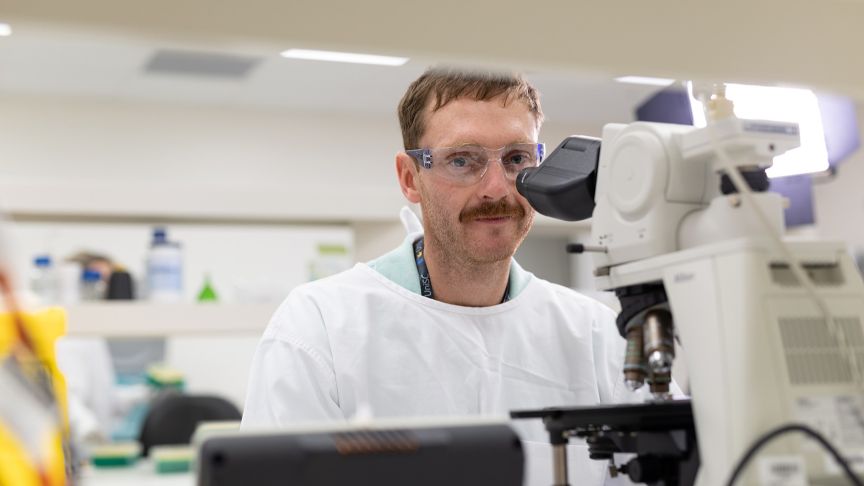
Congratulations to SCHI and UniSC cancer researcher and medical biochemist, Dr Lochlan Fennell along with 22 leading experts received a boost with the establishment of an inaugural $5.8 million national Centre of Research Excellence (CRE) to find the causes of early-onset bowel cancer.
Announced under NHMRC’s Centre of Research Excellence (CRE) 2026 grant opportunity, the CRE scheme provides support for teams of researchers to pursue collaborative research and develop capacity in basic science research, clinical research, health services research and public health research.
The Early-Onset Bowel Cancer Centre of Research Excellence (CRE) is a five-year program that will investigate the aetiology, risk factors, tumourigenesis, exposures, microbiome and immune susceptibilities that are underlying early-onset bowel cancer. Known as CRE ARTEMIS, the centre aims to improve health outcomes and promote or improve translation of research into policy and practice.
The Centre will create a focal point of expertise that fosters and facilitates national collaborative research endeavours focused on the causes of the increase in early-onset bowel cancer.
About 1,900 younger Australians are diagnosed with bowel cancer each year. This has increased dramatically over the past two decades.
SCHI will be part of 4 research institutes and 6 universities involved in the centre, to be led by University of Melbourne Associate Professor Dan Buchanan. It includes four further hospitals and health services including our very own Sunshine Coast Health.
Medical Director of General Surgery at Sunshine Coast Health, Dr Bree Stephensen said, “The General Surgical department at SCUH is witnessing first-hand the rapid and disturbing rise in colorectal cancer in young people, who are not yet eligible for bowel screening and who more frequently present with late-stage disease due to delays in diagnosis. We are passionate about contributing to this important study, the results of which are urgently needed to provide clarity for our young patients and identify modifiable risk factors that can halt the alarming rise in early-onset colorectal cancer.”
The program will focus on three connected themes:
1. Understanding how the gut microbiome influences the development of early-onset bowel cancer;
2. Creating a detailed molecular atlas to map the changes that occur from normal bowel tissue to early-onset polyps and ultimately to bowel cancer;
3. Using functional testing and preclinical models to investigate the causes and pathways of early-onset bowel cancer.
Associate Professor Buchanan said: “The team are all very excited and committed to identifying the causes and mechanisms driving the increasing rates of early-onset bowel cancer.”
CRE ARTEMIS will also train and mentor the next generation of early-onset bowel cancer researchers, developing a national workforce with the cross-disciplinary skills needed to drive innovation in prevention, early detection and future treatment. This will include PhD scholarships and clinical research fellowships being made available to local students and clinicians.
Bowel Cancer Australia has committed $3 million through the NHMRC Centres of Research Excellence to establish the teams of researchers, clinicians and people with lived experience. This will be supported by additional funding of $2.8 million from participating institutions and partners.
Bowel Cancer Australia CEO Julien Wiggins said: “We congratulate Dan and Lochlan on their successful application and look forward to working with the CRE ARTEMIS team as they investigate the causes as to why Australia has the highest rates of early-onset bowel cancer in the world.”
One in eight Australians diagnosed with bowel cancer are aged under 50, and the risk of being diagnosed before age 40 has more than doubled since the year 2000.
Dr Fennell’s research is centred on gastrointestinal cancers, with a particular focus on understanding how these cancers are initiated. He investigates the mechanism behind these processes and works on preventative measures, such a s identifying interventions for patients.
Dr Lochlan Fennell has also been appointed Associate Director and will lead the Centre’s Queensland node. Dr Fennell, who is developing the biobank at the Sunshine Coast Health Institute (SCHI), seeks to determine if modern living is contributing to increased diagnoses.
“This represents an important first step in finding out why more Australians are being diagnosed with bowel cancer and how we can reverse the trend,” he said.
“I am pleased to join CRE ARTEMIS as the centre’s Associate Director. My role is to oversee the data management and analysis portfolio, and as lead of the centre’s Queensland node.”
The Centre was named after the Greek goddess of the hunt, Artemis, reflecting the team’s determination to track down what is causing early-onset bowel cancer and the alarming rise of the disease in young Australians.
Congratulations to Dr Fennell, Associate Professor Dan Buchanan, Bowel Cancer Australia, Sunshine Coast Health and all partner organisations involved in this landmark initiative.
Story adapted from UniSC, and Bowel Cancer Australia.