

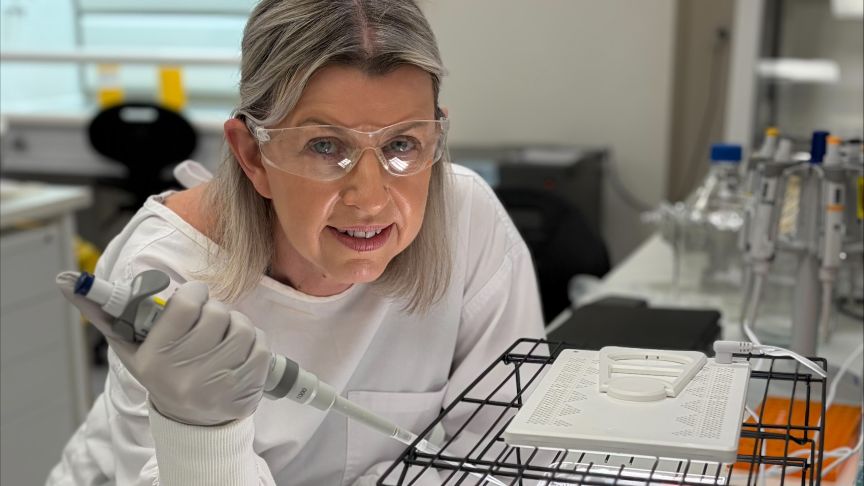
Dr Lisa Randall, Sunshine Coast Health and UniSC Postdoctoral Research Associate in Pharmacology, is investigating why some people respond differently to liver cancer treatments, with the goal of advancing precision medicine approaches for patients.
Hepatocellular carcinoma, the most common form of primary liver cancer, is a highly aggressive disease that affects liver tissue. Through her research, Dr Randall hopes to better understand why some patients respond well to treatment while others experience recurrence or limited treatment success.
Working under the guidance of lead clinician researcher Professor James O'Beirne, Conjoint Clinical Professor & Senior Staff Specialist – Hepatology Sunshine Coast Health and Griffith University, and Lead Principal Investigator Dr Lochlan Fennell, UniSC clinical researcher, Dr Randall is utilising innovative techniques available at SCHI to examine specific regions within liver tissue.
By studying these tissues in detail, the team aims to uncover why some patients experience cancer recurrence and why others fail to respond to standard treatments.
"Some people respond to treatment, and some do not. Sometimes the cancer returns even though we think it's cured. For those people, we want to understand why. Perhaps there is a different treatment approach that is more specific to the individual patient," Dr Randall explained.
With more than 18 years of clinical nursing experience, Dr Randall brings valuable insight to her role as the project's primary laboratory researcher. Her work involves collecting and processing tissue samples, identifying specific tissue regions for analysis, and preparing precision-cut liver slices for investigation. She is also responsible for optimising laboratory procedures and developing best-practice research methods.
The project team recently secured $500,000 in funding over three years to pursue three key research aims.
The first aim is to improve precision medicine by identifying patients who may be at greater risk of developing liver cancer due to underlying diseases. By understanding the biological factors that influence treatment response, researchers hope to tailor therapies to individual patients and improve outcomes.
"We're interested in understanding what is happening within the tissue. Is it the tumour itself, or the surrounding environment, that is influencing cancer development? Certain proteins may promote the growth of cancer, while others may help prevent it. If we identify proteins that appear protective in some patients but not others, these could become important targets for future therapies. Ultimately, we hope to build a much bigger picture of what the tissue is doing," Dr Randall said.
The second aim focuses on refining laboratory processes using innovative, gold-standard technologies to analyse proteins within tissue samples.
One technique being utilised is CyCIF (Cyclic Immunofluorescence), which allows researchers to examine multiple proteins on the same tissue sample. The process uses antibodies attached to fluorescent markers. When stimulated, these markers emit light, enabling researchers to identify and measure the presence of specific proteins within the tissue.
This advanced approach provides a detailed understanding of the tissue environment and helps researchers uncover the biological mechanisms driving disease.
The third aim is to translate laboratory discoveries into real-world clinical benefits.
"If we can get answers from the tissue, we can begin asking important questions. Is there a better treatment option? Is there a better way to diagnose the disease? Can we stop the cancer altogether? The goal is to move into clinical trials and help people. Clinical trials are often the visible outcome, but they're only one-tenth of the process. The research that leads up to them is the other nine-tenths, and that's what keeps researchers motivated to continue," Dr Randall explained.
Dr Randall notes that liver cancer rates continue to rise among people living with fibrosis or cirrhosis, with approximately 2-4% progressing to liver cancer each year.
"We're seeing increasing numbers of people with fibrosis or cirrhosis developing cancer, and we're not entirely sure why. Hopefully, our research will help fit some of the missing pieces of that puzzle together."
Dr Randall's enthusiasm for translational biomedical research is infectious. Her passion lies in bridging the gap between laboratory discoveries and patient care.
"Translating what we do in the laboratory to the bedside is what excites me. SCHI is the perfect place because it brings together so many different disciplines working towards a common goal. It's like a melting pot of expertise. Many diseases share common pathways. For example, fibrosis affects not only the liver, but also the heart, lungs and skin. Bringing different specialisations together creates opportunities for new discoveries."
In addition to her research responsibilities, Dr Randall plays an important leadership role by supervising undergraduate and Higher Degree Research students working on the project.
When asked what advice she would give to emerging researchers, her answer is simple:
"The only way you can truly achieve great outcomes is through collaboration. That might be within your department, across schools, or by reaching out to experts elsewhere. Building relationships and seeking mentorship from people who have been there before is invaluable. Attend conferences, connect with people in your field and outside your field, and never underestimate the value of those conversations."
Supporting and mentoring the next generation of researchers remains a key pillar of the SCHI research framework.
"I really hope to give this project my very best. I'm incredibly lucky to be part of it."
From all of us at SCHI, we couldn't agree more. You've got this, Dr Randall!