

Summary
Sunshine Coast Health Registrar has evaluated the impact of a pilot program called ACCESS-GP (Alternative Cardiology Care Enabled by Specialist Supervision for General Practitioners).
What if improving access to specialist cardiology care wasn't simply about increasing the number of appointments, but rethinking who delivers them? Australian Institute of Health and Welfare (AIHW) data shows that Queensland public hospital specialist outpatient services see approximately 81% of public patients within recommended timeframes. As demand continues to increase, there is an opportunity to further strengthen service delivery models and expand capacity to ensure timely access to specialist care.
The demand for cardiovascular care continues to grow because there are increasing rates of cardiovascular disease and an ageing population. With demand for specialist services continuing to rise, innovative models of care are needed to improve access and support timely diagnosis, clinical testing and treatment, ensuring patients receive the right care at the right time.
In response, Dr Muhammad Hussain, Registrar at Sunshine Coast Health, has evaluated the impact of a pilot program called ACCESS-GP (Alternative Cardiology Care Enabled by Specialist Supervision for General Practitioners). The program was developed under the guidance of Professor Kim Greaves, Co-Director of the Cardiology Department at Sunshine Coast University Hospital and Professor (Conjoint) at Griffith University. ACCESS-GP aims to improve access to specialist cardiology care by supporting general practitioners to manage selected lower-complexity patients within a specialist-supported model of care, expanding outpatient capacity while preserving cardiologist expertise for patients with more complex clinical needs.
By directing appropriate lower-risk and lower-complexity patients to specialist-supported GPSI clinics, the model aims to increase outpatient capacity while allowing cardiologists to focus on patients requiring more complex specialist care.
Dr Hussain explained, "ACCESS-GP began with a simple question: how can we address this gap? At a health service level, we had already tried to improve access by refining referral triage processes and enhancing communication with GPs through The Criteria for Transfer Of Care (TICTOC) research study."
Professor Greaves added, "ACCESS-GP demonstrates the value of rethinking traditional models of outpatient care. Muhammad's research provides important insights into how we can deliver more accessible, cost-effective and patient-centred services."
While general practitioners play an established role in cardiovascular disease management, there is limited evidence evaluating formally trained GPSIs working within specialist-supported, hospital-based cardiology outpatient services.
The first phase of the research involved Professor Greaves implementing a General Practitioner with a Special Interest (GPSI) Clinic within the Sunshine Coast Health Cardiology Department. Two community GPs undertook a structured cardiology education program incorporating consultant supervision, weekly teaching, clinical case discussions and progressive development of specialist clinical skills over 12 months.
The aim was to develop the clinical knowledge, confidence and capability required to manage appropriately selected cardiology patients with increasing autonomy, within an established specialist-supported governance framework.
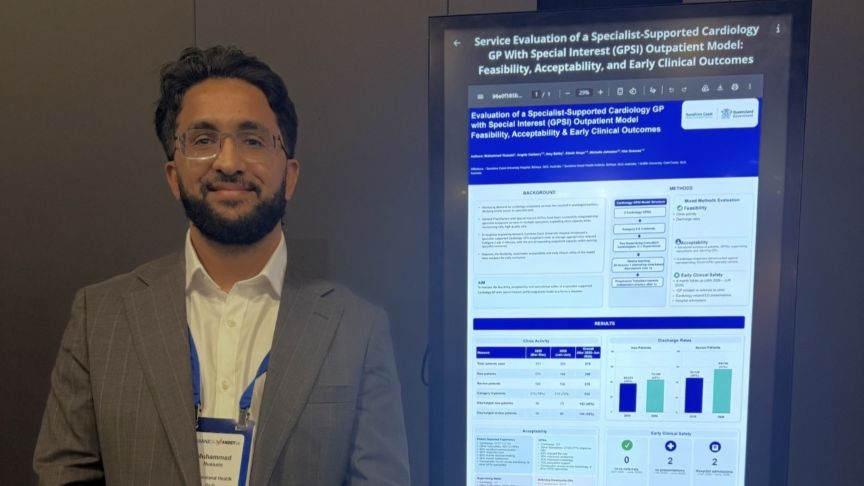
The next phase, led by Dr Hussain, evaluated the model's feasibility, acceptability and early clinical safety. Researchers examined clinic activity, discharge outcomes, stakeholder experiences and subsequent healthcare utilisation. The results have been overwhelmingly positive.
"Patients are highly satisfied with the care they receive through this model and appreciate the holistic approach that GPs bring to a specialist setting," Dr Hussain explained. "The GPs themselves have been overwhelmingly positive about the role. They found it professionally enriching and valued the opportunity to expand their skills while contributing to an important area of healthcare need.
Early feedback from responding community GPs was positive, particularly regarding communication and the potential for improved coordination between primary and specialist care. They appreciate that their patients are able to access specialist care sooner and value the close communication between Sunshine Coast Health outpatient services and general practice."
Discharge rates also increased across the evaluation periods, from 38% to 43% for new patients and from 46% to 57% for review patients, suggesting the potential for the GPSI pathway to support more efficient outpatient management.
The cardiology GPSI model shows considerable promise. Its positive reception suggests it could be expanded across Sunshine Coast Health into other specialities and potentially adopted by Hospital and Health Services across Australia. By helping to bridge the gap between demand and specialist capacity, this model could enable patients and their families to access specialist care sooner.
SCHI has been instrumental in bringing this project to life. The SCHI Research Translation team guided Dr Hussain throughout the process, helping him understand the fundamentals of research project development, proposal writing, ethics applications, and survey design.
For Dr Hussain, ACCESS-GP has also been an opportunity to develop research capability alongside clinical training, demonstrating how emerging clinicians can contribute to evaluating and improving healthcare delivery. He has been driven by a desire to contribute to evidence-based research in his field of interest.
"Without SCHI, I would not have been able to bring this project to where it is today," he said.
Dr Hussain emphasises that conducting research is achievable, even for clinicians without advanced research qualifications.
"For many junior doctors, research can seem intimidating. Writing papers and presenting findings can be daunting. However, it's about taking a chance and embracing opportunities to try something new. You don't need to be a PhD candidate or have a master's degree to make a meaningful contribution to healthcare. Anyone can contribute to improving the health of our state and nation."
What's Next? Dr Hussain recently presented ACCESS-GP evaluation findings at the Queensland Cardiovascular Research Network (QCVRN) Annual Research Showcase, where he outlined the implementation and evaluation of the Cardiology GPSI model of care at Sunshine Coast Health.
Building on the initial evaluation, the research team is exploring opportunities for longer-term outcome assessment, economic evaluation and implementation of specialist-supported GPSI pathways across other health services.
Dr Hussain is now preparing a scientific journal article to further strengthen the evidence base supporting this model of care.
"This is where real policy change happens," Dr Angela Carberry, Research Program Manager at SCHI said. “This is real-world research enabled by SCHI.”
SCHI continues to champion research capability development at every level, from medical students and allied health professionals to senior medical officers.
A special thank you to Professor Greaves for dedicating time to mentoring emerging researchers and helping build research capacity within our community.
And finally, good luck to Dr Hussain for the remainder of your specialist training journey.